The Fall of the House of Usher
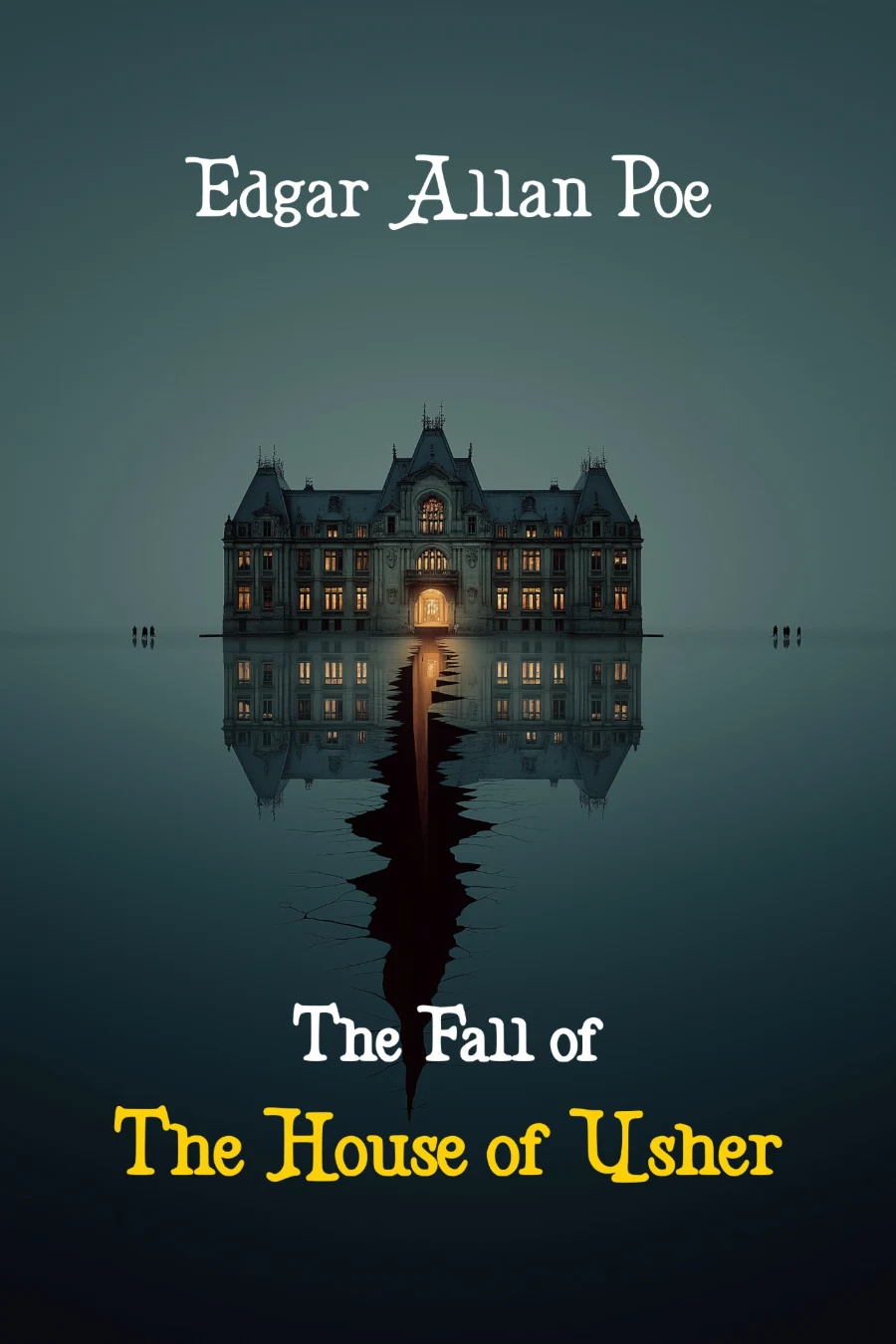
A nameless narrator arrives at a remote ancestral mansion to visit his childhood friend Roderick Usher, who has summoned him with a desperate letter speaking of acute mental distress. The house itself greets him like a living thing—its vacant eye-like windows, its fissure splitting the facade from roof to foundation, its reflection shimmering in the dark tarn that surrounds it. Inside, he finds Roderick wasted by a mysterious nervous affliction, hypersensitive to all stimuli, and living in semi-isolation with his twin sister Madeline, who suffers from a strange cataleptic malady. The estate and its inhabitants seem locked in a symbiotic decay, each feeding the other's dissolution.
Poe constructs an atmosphere of almost unbearable psychological claustrophobia, where the boundaries between the physical and mental, the living and the inanimate, begin to dissolve. Every detail contributes to the mounting dread: the oppressive furnishings, the abstract paintings Roderick creates in his feverish state, the improvised ballad he performs about a palace consumed from within, even the peculiar luminescence of the air itself. The story operates on the principle that environment and psyche are inextricable, that a house can absorb and reflect the madness of its occupants across generations. Gothic horror here becomes psychological horror, with supernatural suggestions that remain tantalizingly ambiguous, never quite confirming whether the terror springs from diseased imagination or genuine otherworldly forces.
This tale endures as perhaps the purest distillation of Gothic atmosphere in American literature, a concentrated study in mood and mounting anxiety that influenced everything from cosmic horror to psychological thriller. It rewards readers who appreciate prose as texture, who can feel the weight of ancient draperies and taste the metallic air of enclosed spaces. Those drawn to stories where setting becomes character, where the line between reality and perception blurs, and where dread accumulates through suggestion rather than explicit violence will find this brief work immensely satisfying.