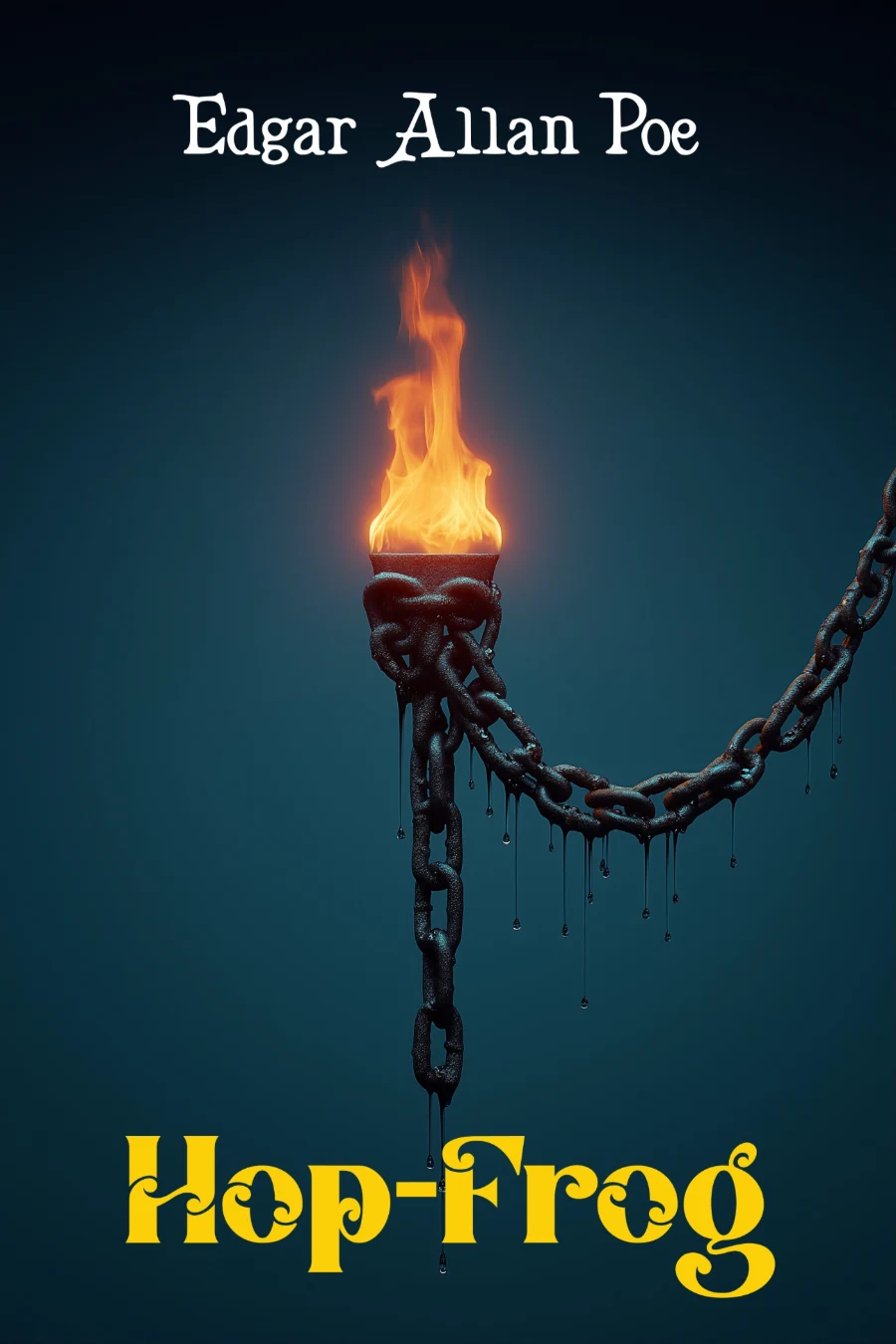
Hop-Frog
In the opulent court of an unnamed king, two captives serve as entertainment: Hop-Frog, a dwarf whose physical limitations make him the butt of cruel jests, and his companion Trippetta, a dancer from the same distant land. The king, fond of practical jokes that verge on torture, and his seven ministers demand elaborate pranks and masquerades to satisfy their appetites for spectacle. When commanded to devise a costume for an upcoming ball, Hop-Frog finds himself pushed beyond endurance by his tormentors, who force wine down his throat despite knowing his painful intolerance, and who humiliate Trippetta for daring to defend him.
Poe crafts this tale with the tight precision of a wound spring, building tension through the suffocating atmosphere of the court where power is absolute and mercy nonexistent. The story examines the dynamics of humiliation and servitude with unflinching clarity, showing how prolonged cruelty accumulates like pressure in a sealed chamber. What distinguishes this from Poe's other revenge narratives is its theatrical setting—the entire court becomes both stage and trap, where performance and reality blur in ways that serve the story's devastating logic. The tone shifts from dark comedy to something more chilling as Hop-Frog's keen intelligence, so often mocked, begins to reveal itself in the planning of an elaborate entertainment.
This compact tale endures as one of Poe's most pointed explorations of power, degradation, and the lengths to which oppression can drive the oppressed. It rewards readers interested in psychological complexity wrapped in the trappings of gothic spectacle, and those who appreciate how Poe could distill potent social commentary into taut narratives that work simultaneously as entertainment and indictment. The story's brevity only intensifies its impact, leaving no room for sentiment or evasion.