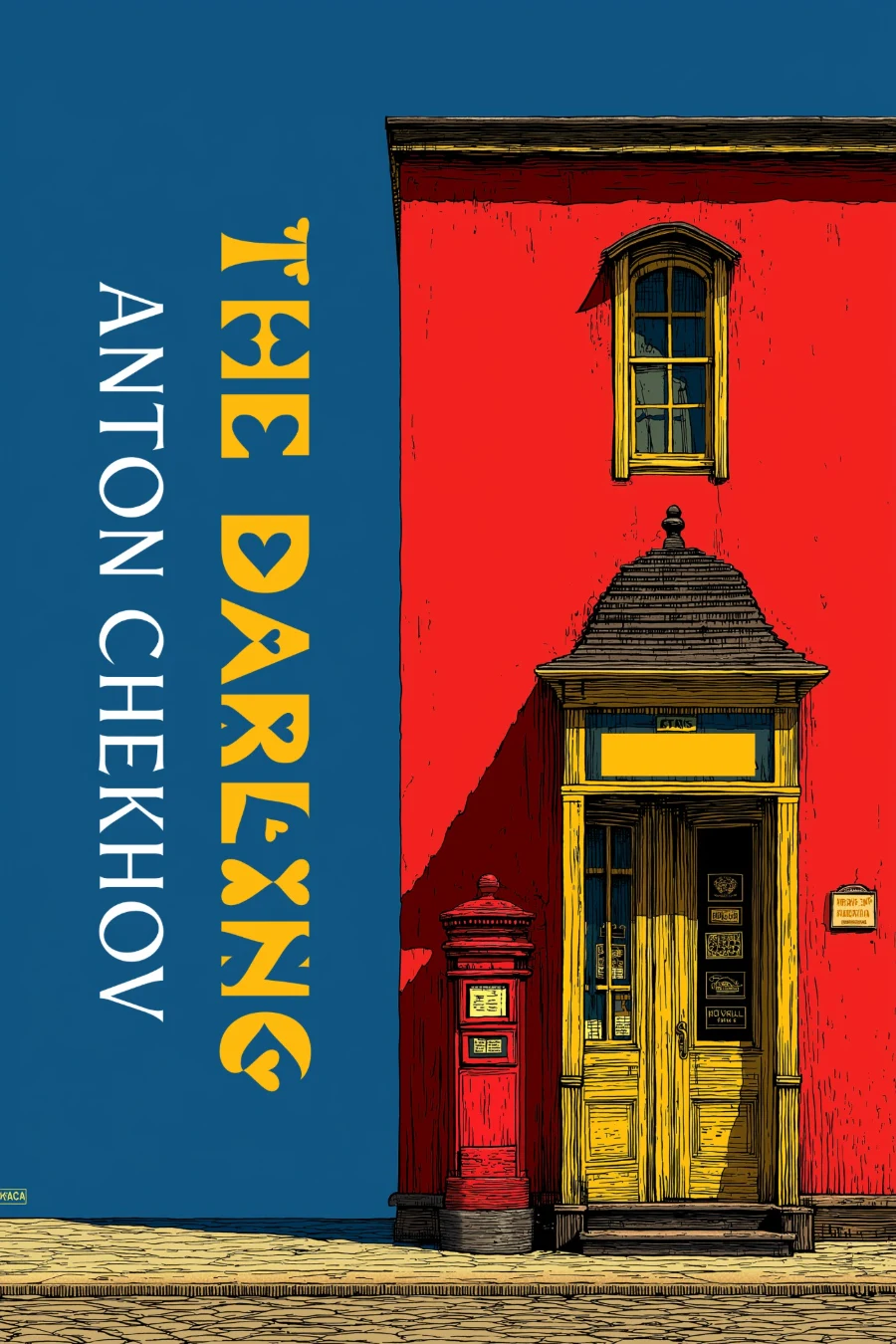
The Darling
In a provincial Russian town, we meet Olenka, a woman whose capacity for devotion knows no bounds. She is called "the darling" by everyone who knows her, and this endearment captures both her gentle nature and something more unsettling about her character. Olenka cannot exist without someone to love—she must pour her entire being into another person, adopting their opinions, their interests, their very way of seeing the world as completely as if she had no inner life of her own.
Chekhov traces Olenka's life through her relationships with dispassionate precision, watching as she transforms herself again and again to match whoever currently occupies the center of her existence. The story moves through different phases of her life with deceptive simplicity, yet each transformation raises increasingly uncomfortable questions about identity, love, and the difference between devotion and self-erasure. Chekhov's prose is characteristically spare and ironic, never quite telling us how to feel about Olenka. Is she admirable in her selfless capacity for love, or is there something tragic—even parasitic—in her inability to exist independently? The story refuses easy answers, and this ambiguity has made it a subject of fierce literary debate.
This brief work has haunted readers and sparked controversy for over a century, partly because it operates like a moral inkblot test: what you see in Olenka reveals much about your own assumptions regarding gender, selfhood, and the nature of love. The story rewards readers interested in psychological complexity compressed into compact form, and those willing to sit with the discomfort of a character who defies simple categorization. Chekhov's genius lies in making us feel both tenderness and unease, sometimes in the same moment, as we follow a life lived entirely in reflection of others.