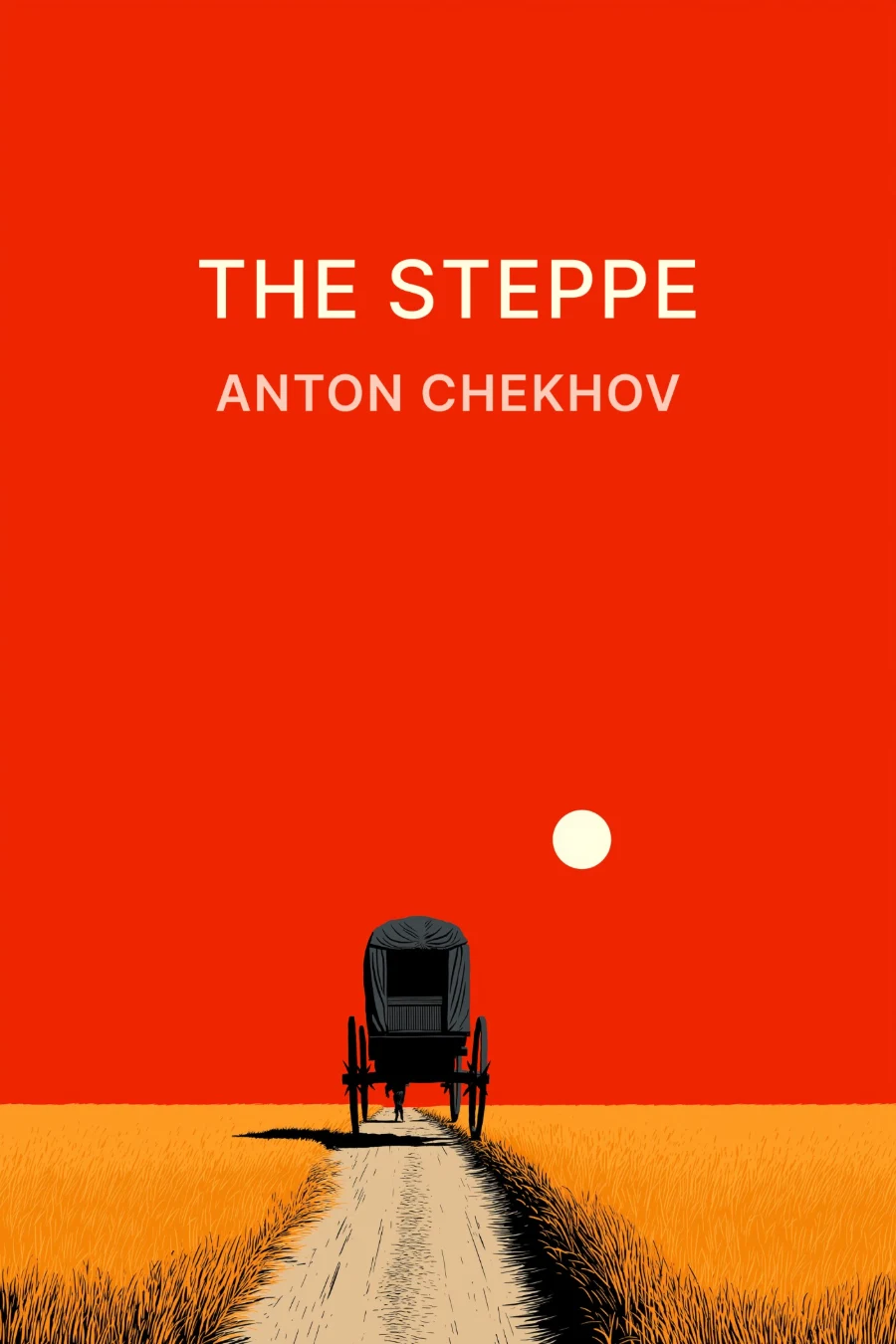
The Steppe
3h 13m
38,465 words
en
A nine-year-old boy named Yegorushka embarks on a long journey across the Ukrainian steppe with his uncle, a merchant, and a priest, traveling to a distant town where he will attend school for the first time. Leaving behind everything familiar, the child experiences the endless grasslands as both monotonous and overwhelming—a landscape so vast it seems to erase human significance, yet teeming with subtle variations that only reveal themselves through patient observation.
Chekhov transforms what could be a simple coming-of-age tale into something stranger and more hypnotic. The steppe itself becomes the true subject, rendered through Yegorushka's increasingly feverish consciousness as an alien territory where time moves differently, where days blur into one another under the relentless sun. The novel moves with the pace of the journey itself—slow, sometimes tedious, punctuated by encounters with peasants, drovers, and wanderers whose stories emerge and fade like mirages. What distinguishes this work is Chekhov's ability to find both beauty and terror in emptiness, to capture how landscape can shape consciousness. The writing oscillates between lyrical descriptions of clouds and storms and stark observations of human cruelty and kindness, all filtered through a child's limited but intensely receptive awareness.
This short novel rewards readers willing to surrender to its rhythms rather than expect conventional narrative momentum. It offers an immersive experience of displacement and wonder, showing Chekhov's mastery of psychological realism applied to the inner life of a child confronting the vastness of the world. Those drawn to literature that privileges atmosphere and perception over plot, who find meaning in the textures of ordinary experience, will discover in these pages a profound meditation on solitude, growth, and the strange beauty of desolation.
Russian RealismComing-of-AgeUkrainian SteppeJourney NarrativeChildhood InnocenceNature and LandscapeExistential LonelinessPastoral LiteratureLoss of InnocenceContemplative MoodSocial Class in Tsarist RussiaLyrical Prose
PublisherKafka
LanguageEnglish
Source
short-fiction-anton-chekhov