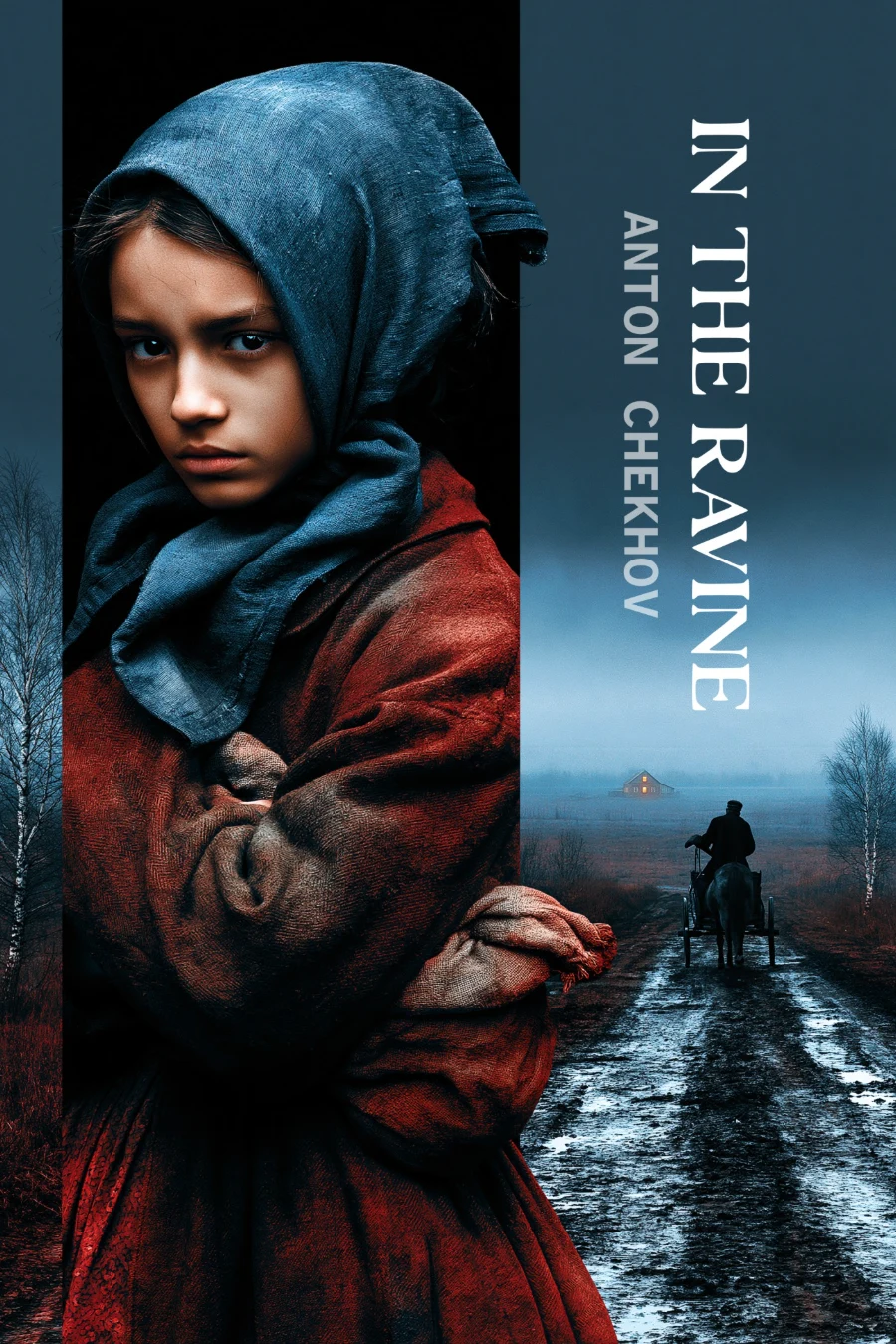
In the Ravine
The village of Ukleyevo lies in a ravine through which the local stream carries the runoff from three cotton mills and a tannery. The Tsybukin family — old Grigory the shopkeeper, his slow son Anisim who works in town for the police, his other son Stepan who is deaf, and his daughter-in-law Aksinya who runs the shop with cold competence — sits at the centre of the village's small economy. Anisim returns from town to marry the gentle, religious Lipa, who is too poor to refuse the match. Aksinya, who has long ruled the household, watches her newest sister-in-law arrive with the same close attention she gives to the accounts. Within months Anisim is arrested for passing counterfeit roubles. The two women — the saint and the predator — are left in the house together with the family's gathering wreckage.
Chekhov wrote In the Ravine in 1900, at the very end of his life, and many readers consider it the supreme accomplishment of his late short fiction. It is the most novelistic of his stories, working at the scale of a small George Eliot novel compressed into sixty pages. The village's whole social organism is rendered — the priests, the carpenters, the cattle dealer, the doctor — and the Tsybukin family's particular fate becomes the story of how an entire rural Russia might be lit and shadowed at once. The famous central scene — Aksinya's act against Lipa's baby — is one of the most shocking moments in nineteenth-century literature, and is also one of the most measured: Chekhov refuses every dramatic flourish and lets the horror surface in the very flatness of the description.
In the Ravine rewards readers who want to see Chekhov work at the longest reach of his short form, with the patience and breadth of his major plays. It rewards them with one of the great endings in his canon: Lipa walking home along a country road with her singing, a stranger offering her a cucumber, the evening sky over a village where it is still possible, in spite of everything, to make a kind of small, partial peace with what has happened.