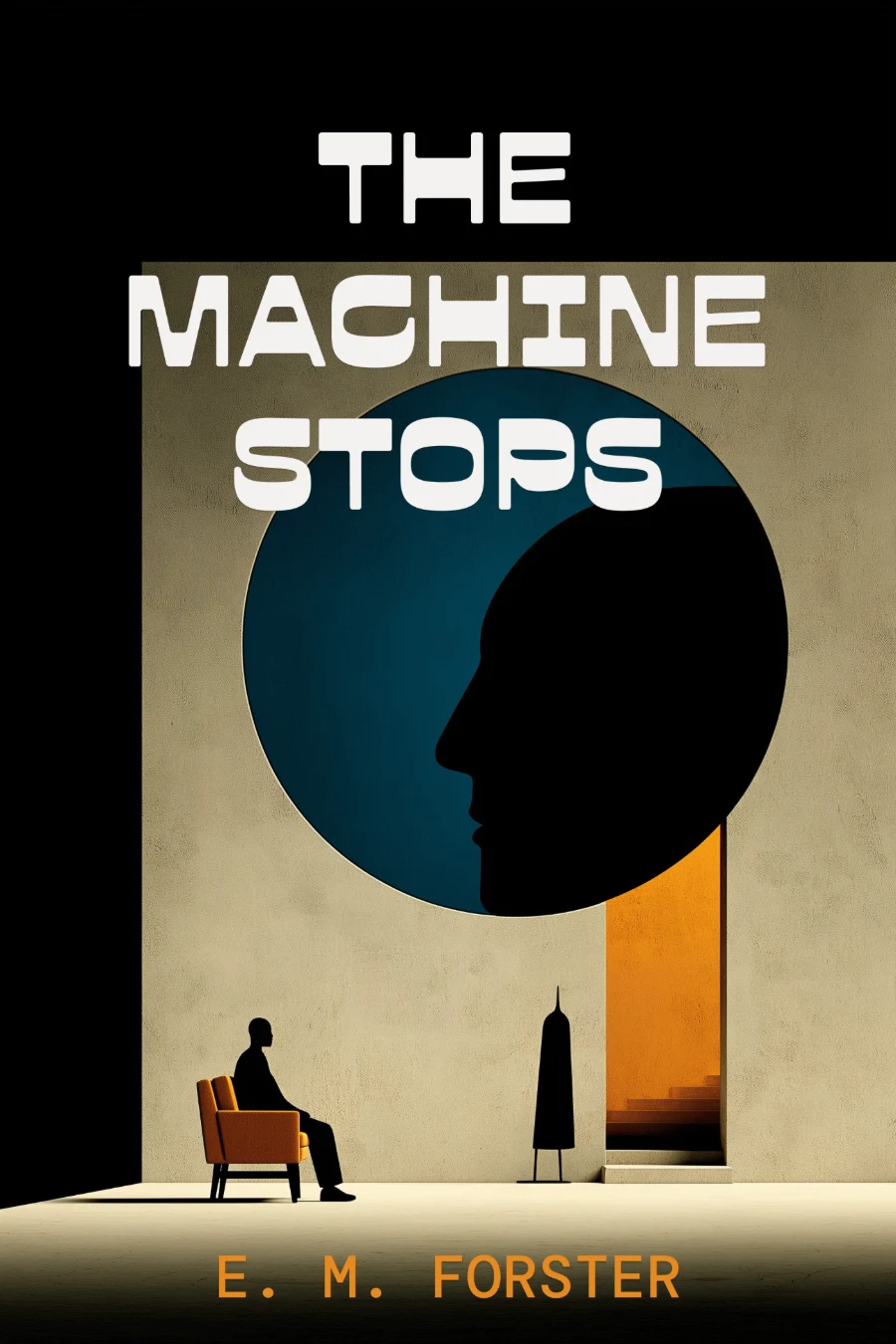
The Machine Stops
1h 2m
12,266 words
en
Imagine, the narrator begins, a small room shaped like the cell of a bee. In it is everything a human being could require — temperature, food, music, instruction, the company of thousands of distant friends through a glowing blue plate. Vashti, a respected lecturer, communicates from her cell with her son Kuno, who lives on the other side of the planet but is reachable in a fraction of a second through the Machine that sustains them both. He has a request that strikes her as almost obscene: he wants her to make the long aeroplane journey, in person, to see him.
E. M. Forster published this story in the Oxford and Cambridge Review in November 1909, almost a century before the technology it describes. He wrote it, by his own account, partly in protest against the cheerful technological utopias of H. G. Wells. The story imagines an entirely indoor humanity that has come to revere the Machine that serves it as a kind of god, that prefers mediated communication over the rawness of presence, and that has lost so completely the capacity to act on the physical world that it cannot imagine the surface above its honeycomb. When the Machine begins, almost imperceptibly, to fail — first in a faulty music recording, then in a dimming of the light, then in pressure to abandon non-essential maintenance — no one in the population is equipped to understand what they are hearing.
The Machine Stops rewards readers who want to read the foundational dystopia of the twentieth century — the text that anticipated video calls, social isolation, the internet, the smartphone, and the strange willingness of a population to defer to systems no individual fully understands. It is short, propulsive, devastating, and uncomfortably contemporary. Anyone who has read it during a global pandemic, or stared at a screen instead of opening a door, has felt the small electric shock of recognition that has made this 1909 story the most quoted prophecy of the digital age.
PublisherKafka
LanguageEnglish
Source
short-fiction-e-m-forster