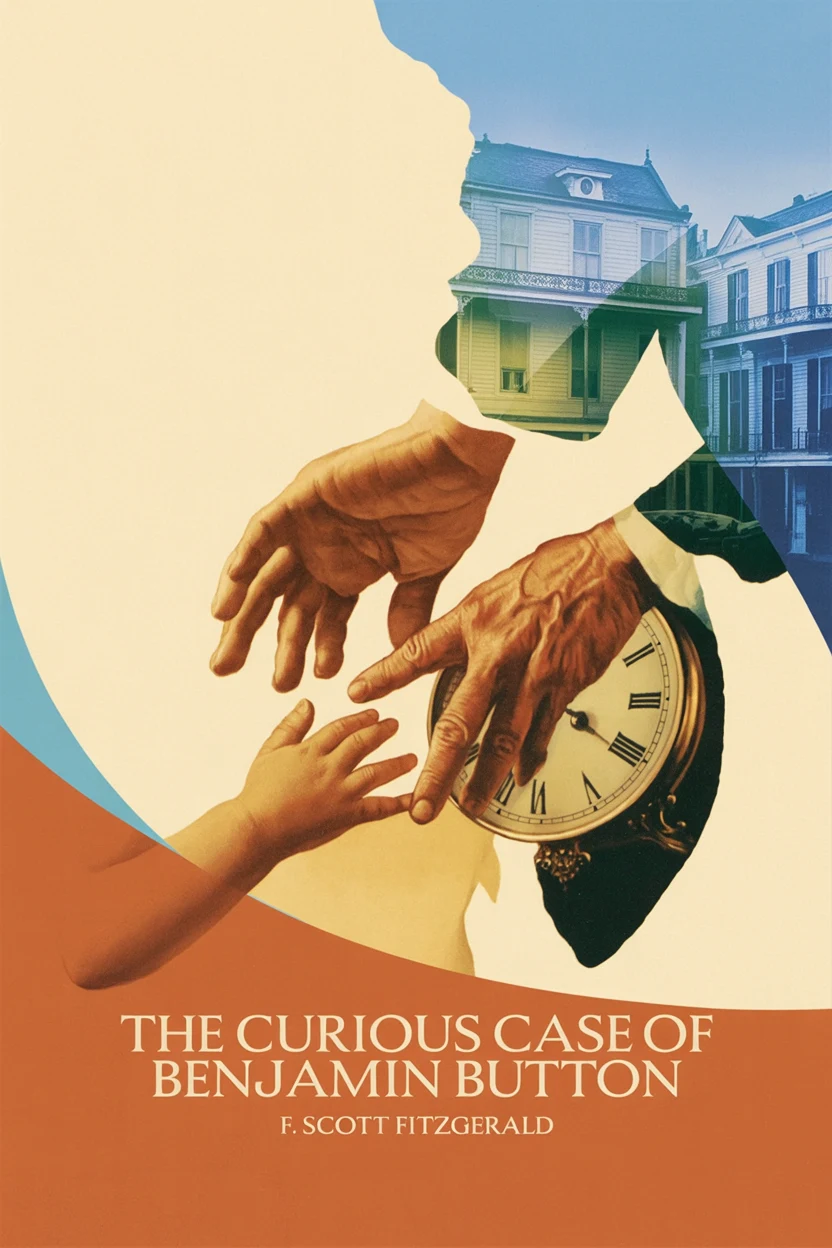
The Curious Case of Benjamin Button is a fantastical short story published by F. Scott Fitzgerald in 1922 in Collier's magazine and later included in his collection Tales of the Jazz Age. The narrative follows the extraordinary life of Benjamin Button, who is born as a seventy-year-old man and ages backward, growing physically younger as the years progress. Born to a prominent Baltimore family in 1860, Benjamin's unusual condition causes his father profound embarrassment and social anxiety. As Benjamin reverse-ages through the decades, he experiences life's milestones in inverted order: he attends Yale as an elderly-looking young man, fights in the Spanish-American War during his middle age, falls in love and marries during what appears to be his fifties, and gradually regresses through adulthood, adolescence, childhood, and infancy, ultimately fading from existence and memory.
Fitzgerald uses this absurdist premise to explore profound themes about the nature of time, identity, mortality, and society's obsession with youth and aging. The story serves as a satirical commentary on how society judges people based on physical appearance and age, revealing the arbitrary nature of social conventions and expectations. Benjamin's backward journey illuminates the tragedy inherent in all human life—the loss of mental faculties, the dissolution of relationships, and the inevitable march toward nothingness, whether experienced forward or in reverse. The story also examines themes of adaptation, acceptance, and the immutability of biological fate despite one's desires or social position.
While not as celebrated as Fitzgerald's novels during his lifetime, The Curious Case of Benjamin Button has endured as one of his most imaginative and philosophically rich short works. The story gained renewed cultural relevance with the 2008 film adaptation starring Brad Pitt, which introduced Fitzgerald's meditation on mortality and the human condition to contemporary audiences. The tale remains significant as an early example of speculative fiction from a literary heavyweight and continues to resonate because it transforms the universal human anxiety about aging into a poignant, unforgettable narrative that questions what it truly means to live a human life.