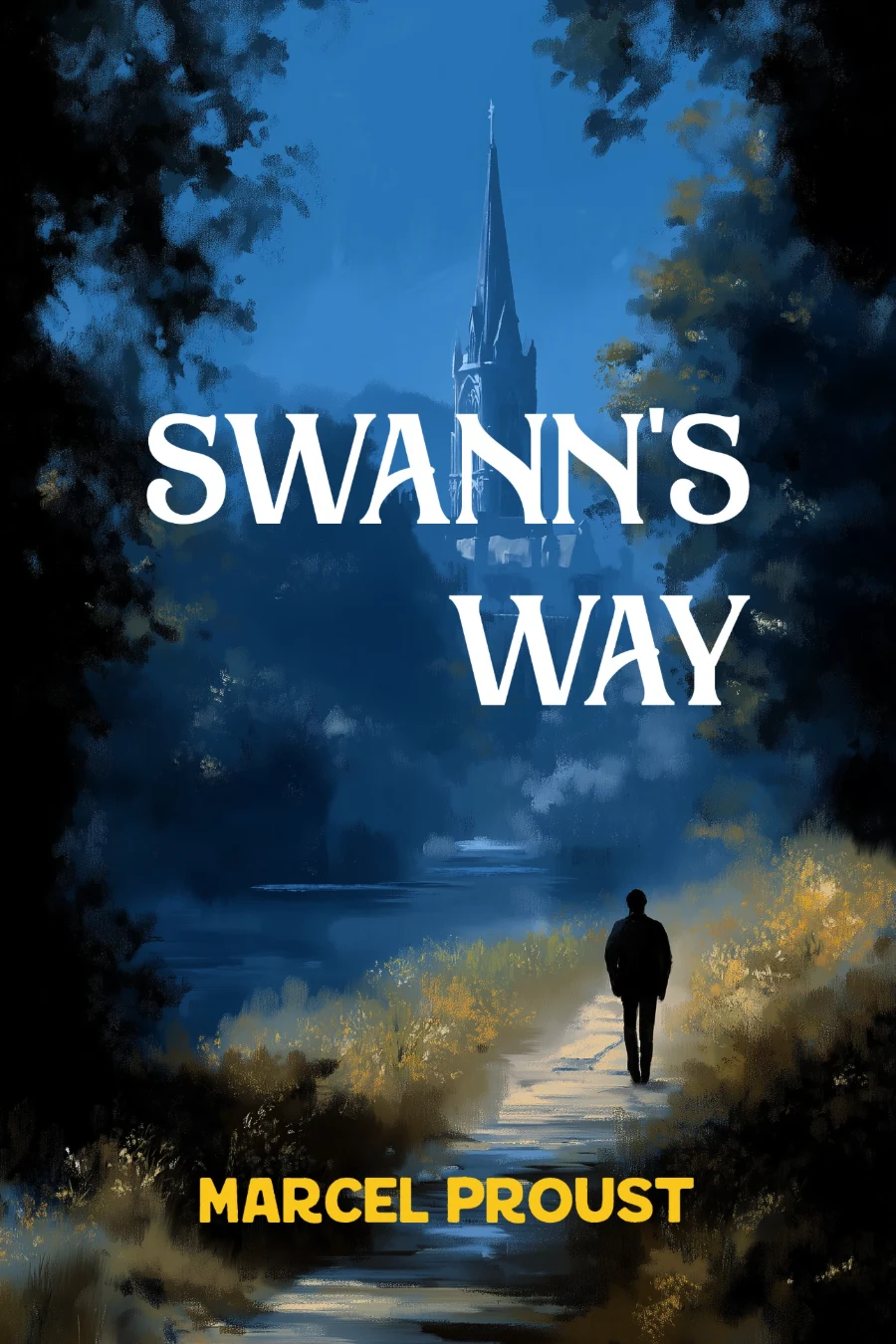
Swann's Way
A single moment—the taste of a madeleine dipped in tea—becomes the key that unlocks an entire vanished world. The narrator, lying awake in the darkness of his adult life, finds himself transported back to the Combray of his childhood, where the rituals of provincial French life played out with the weight of sacred ceremonies. Through the seemingly trivial events of going to bed, waiting anxiously for his mother's goodnight kiss, and observing the social dramas of his family and their circle, Proust reconstructs not just memories but the very texture of consciousness itself.
What emerges is less a conventional narrative than an immersion into the workings of memory, desire, and perception. The book moves at the pace of thought rather than plot, lingering over a hawthorn hedge or the complex social maneuvering of the bourgeoisie with the same intense attention. We follow the narrator's fascination with the mysterious Swann, a wealthy Jewish art connoisseur who has married beneath his station, and gradually enter Swann's own history of obsessive, destructive love for Odette, a courtesan who becomes the unwitting center of his existence. Proust's sentences unfurl like chambers within chambers, each observation giving way to another layer of reflection, creating a prose that mirrors the associative nature of memory itself.
This is literature that demands a different kind of reading—slow, contemplative, receptive to digression and nuance. Proust treats the minutiae of bourgeois life with the gravity of epic, finding in tea parties and evening walks the profound questions of how we experience time, how we love, and how we become who we are. The book rewards readers willing to surrender to its rhythms, those who find beauty not in what happens next but in the infinite depths of what has already occurred, filtered through the prism of recollection.