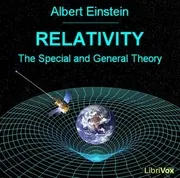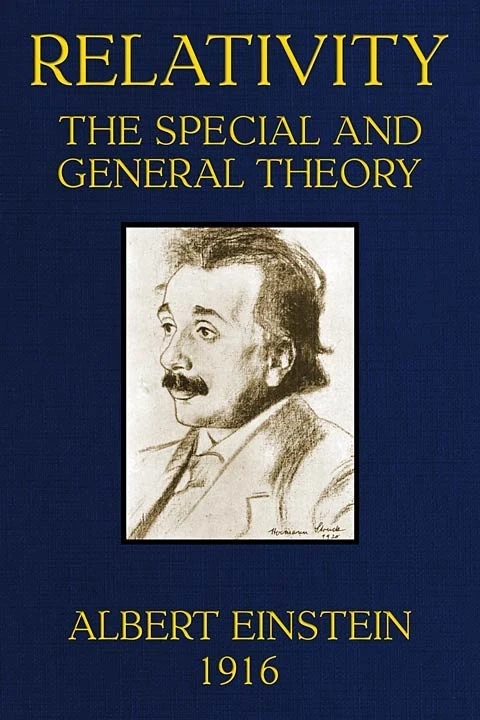
Relativity: The Special and General Theory
Einstein wrote this book for the educated lay reader within a year of completing the general theory of relativity, in part out of irritation that the popular accounts then circulating were so often wrong. The result is a strange and durable little book — a treatise written by the person who actually solved the problem, in something close to plain prose, with the mathematics relegated to appendices that can be skipped without losing the argument.
The book moves in three movements. The first is special relativity, derived almost conversationally from two postulates — the relativity of motion and the constancy of the speed of light — and walked outward into its consequences for time, simultaneity, mass, and energy. The second is general relativity, where the apparatus has to thicken to accommodate gravitation as the geometry of spacetime itself. The third is a short and lovely concluding section on the question of whether the universe as a whole is finite or infinite, a question Einstein answers (or rather, refuses to answer) with characteristic care.
Robert Lawson's 1920 translation, prepared in consultation with Einstein himself, has remained the standard English version through a century of relativity literature. What makes the book extraordinary is not that it is easy — it is not — but that the difficulty is precisely the difficulty of the physics, never the difficulty of the prose. A patient reader can follow Einstein's reasoning step by step until, somewhere in the general theory, the world becomes stranger than they had known it could be.